Monday, 14 July 2014

The wonderful Pyrenees in early summer (Day 3 17/06/14)

FOR the third day we were determined to see one of the most famous sites in the Pyrenees and to get some walking in, i.e. the Cirque de Gavarnie.

Rather than approach it directly we climbed a hill opposite to the north to get a wider view from the Plateau de Saugue, using a recommended path in Roger Budeler's book "Pyrenees 2 - French Central Pyrenees: Arrens - Seis", which provides a lists of "The finest valley and mountain walks", or so it claims [Pub: Rother].  Bob Gibbons also recommends this area for its outstanding rich alpine hay meadows - and so do we; we were not disappointed.

The walk was basically up and down with very little on the level, except the plateau meadows at the top. The view back to the cirque was spectacular and eating our fresh baguette, ham and goats cheese lunch with that view in the bright sunshine was a perfect moment and a real highlight.

We started surrounded at the bottom by a number of valley meadows, climbed up through a steep area of rocky limestone outcrop, with scattered trees and grazed grassland, then on up to the open, large meadows, which ran up to the foot of the mountains.

Meadow Clary


Climbing up out of the trees and onto the grazed grassland:

 
Hummingbird Hawk-moth at a fragrant orchid
Fritillaries
Skipper

 
Aster
Broomrape
St Bernard's Lily
Asphodel
Burnt Orchid
Saxifrage
Mountain houseleek- Sempervivum montanum?
 

Pyrenean Hyacinth
Burnt orchid next to juniper

At last the view from our lunch spot - pretty special looking back towards the cirque.


Black Vanilla Orchid
Lesser Butterfly Orchid
Finally on to the plateau - the target of our walk and its wonderfully rich hay meadows:


Panorama


Close up view of the sward


Where the ground was particularly damp a huge stand of globe flowers were standing out like a conference of zebra crossings poles


Even in the meadows where it seemed superficially less rich, there were every species hoped for plus burnt orchids and frog orchids all over the place...


Commoner species like greater yellow rattle (Rhinanthus alectorolophus) permeated the sward, although there are a number of species that these could have been.


After we had had our fill we returned down the hill using roughly the same route.  Where the cattle had been and left their mark, numerous small blue butterflies gathered:


In a number of places large spikes of asphodel grew up, possibly immune to the grazing due to being unpalatable.


Even is a bare patch of earth in a poached corner a perfect lesser butterfly orchid grew - lit by dappled sunshine.


Almost back to the bottom of the walk the meadow edges were extra rich with rampion and monkshood everywhere you looked.


If you get a chance to go to this location one spring before the hay is cut - don't hesitate!


Thursday, 10 July 2014

The wonderful Pyrenees in early summer: Val de Jeret (Day 2 16/06/14)

Following our successful reccy on day 1, we decided to take the cable car at the head of the Val de Jeret and walk from there to the Lac de Gaube and beyond along the GR10; this saved our legs a little and gave us more time to spend at higher altitudes.  We did a circuit and on our return trip walked down the mountain back to the base of the lift.  It was a long day with some tiring walking on the long descent (of all things), but it was well worth it.


Lac de Gaube

Admiring the cascade

The wonderful and varied flowering plants present are those normally found on limestone and are similar in many ways to what we see back home, plus more acidic species too; here though there is more variety and just lots more of them over a much more extensive area.  However where the ground is saturated, or water runs through it, the nutrients are poor and plants like butterwort appear in the mix, flowering amongst mossy patches, with orchids liberally scattered between - this was an amazing sight.


Globe flowers
Globe flowers are the show-offs of the buttercup world, as their yellow flowers are particularly big and blousey.  In the UK they have a very restricted distribution.  On our holiday they were not common, but where the conditions of saturated ground were present and low level grazing they thrived.

The butterworts trap insects on their leaves to supplement their diet, as the soil in which they grow is poor in nutrients, giving them a competitive advantage over other species.


Butterwort


The alpenrose was spectacular and seemed to be a perfect fit on this mountainous habitat - I had to keep telling myself that it was not an invasive weed as it is at home in our countryside.


Rhododendron - Alpenrose
Scattered over large patches were the spikes of the asphodel.  I suspect that the grazing animals do not like to eat this plant as it stands head and shoulders above everything else.


Asphodel
There are so many orchids growing everywhere that it can be overwhelming.  I tried to capture this one to show how the landscape and the plants together provide such a wonderful scene.


Early Purple Orchid
There are lots of other species that crop up along the way.  As you ascend the conditions (i.e. lower temperature, higher rainfall, longer snow persistence, shorter growing period, more drying from the wind, depth of soil) become harsher and also the land management varies.   The plants will only grow where they are adapted to cope with these conditions. 
The sub-alpine zone where we were largely walking, but we did also visit higher locations and it was clear to see the differences in the species present.


Meadow? Saxifrage


Cowslip

Long-flowered Primrose


Mignonette-leaved? Bittercress

Southern Marsh Orchid?


There are certain species that speak of a high altitude existance, for example some of the gentians, thrifts, saxifrages and snowbells (see below).  These are classics of the mountains.

You have to time your visit right to see them in flower (which we did!).  Inevitably, however, if you visit for just one week in a year, some other species will have flowered already or are yet to appear; but by hunting carefully where conditions are most harsh, a few examples of the early season flowers can still be found, and by finding areas were conditions are particularly sheltered examples of precocious early flowering individuals can also be discovered.  The next blogs provide some great examples of both of these scenarios, with daffodils and a fritillary (early season) and iris (later season).


Mountain? Thrift

Birdseye Primrose

The diminutive Frog orchid

Moonwort (a very small but exciting fern)


Butterwort

Southern? Gentian


Butterwort


Alpine Poppy


Some higher altitude species:


Alpine snowbell

 
Moss campion - an example of a low glowing plant able to survive harsh conditions

Some of this winter's snow still lay on the ground at the level that we were at.  All the mountains still had lots of snow on their tops too.  Here the snow and fallen onto a river (perhaps frozen at the time?) and now that the weather is warmer the flowing water has created a tunnel.


Pyrenean? Avens


The path lead us up to the cirque at the foot of the rocky mountain slopes.  We ran out of time and energy but were glad to make it to this height.  The sward was very short and one of the graziers were the marmots.  The snow has a large effect on retarding the growth of the grass and it looked like it had not long gone from this area.


A marmot

There are around 200 endemic Pyrenean plant species - an endemic species is one that is specific to a certain, defined area and which evolved in this locality, such as the Pyrenean buttercup.


As high as we reached

Pyrenean Buttercup - not found below 1700m - the only flower in some areas
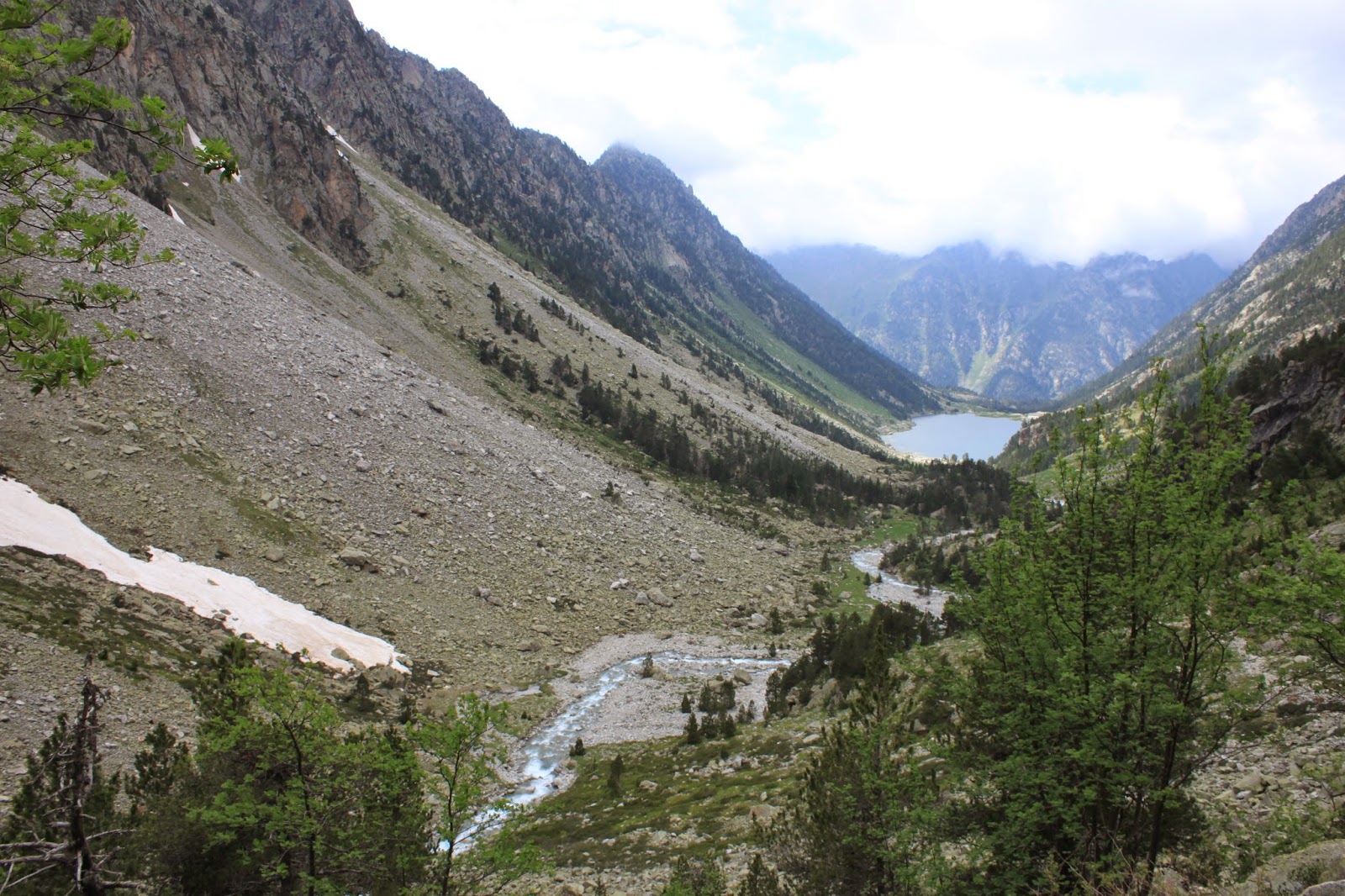
A final view on our descent: