Thursday, 10 July 2014

The wonderful Pyrenees in early summer: Val de Jeret (Day 2 16/06/14)

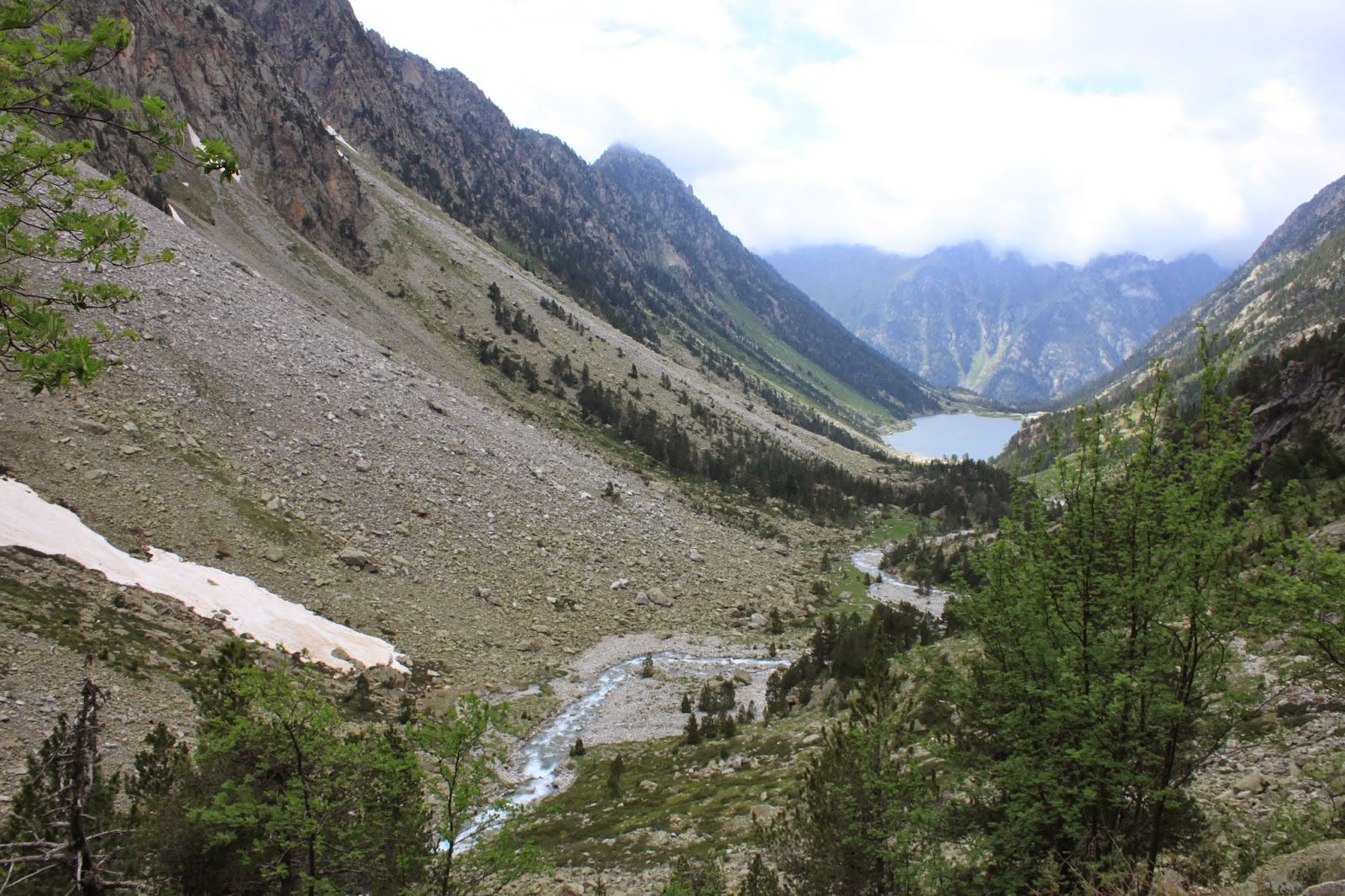
Following our successful reccy on day 1, we decided to take the cable car at the head of the Val de Jeret and walk from there to the Lac de Gaube and beyond along the GR10; this saved our legs a little and gave us more time to spend at higher altitudes.  We did a circuit and on our return trip walked down the mountain back to the base of the lift.  It was a long day with some tiring walking on the long descent (of all things), but it was well worth it.


Lac de Gaube

Admiring the cascade

The wonderful and varied flowering plants present are those normally found on limestone and are similar in many ways to what we see back home, plus more acidic species too; here though there is more variety and just lots more of them over a much more extensive area.  However where the ground is saturated, or water runs through it, the nutrients are poor and plants like butterwort appear in the mix, flowering amongst mossy patches, with orchids liberally scattered between - this was an amazing sight.


Globe flowers
Globe flowers are the show-offs of the buttercup world, as their yellow flowers are particularly big and blousey.  In the UK they have a very restricted distribution.  On our holiday they were not common, but where the conditions of saturated ground were present and low level grazing they thrived.

The butterworts trap insects on their leaves to supplement their diet, as the soil in which they grow is poor in nutrients, giving them a competitive advantage over other species.


Butterwort


The alpenrose was spectacular and seemed to be a perfect fit on this mountainous habitat - I had to keep telling myself that it was not an invasive weed as it is at home in our countryside.


Rhododendron - Alpenrose
Scattered over large patches were the spikes of the asphodel.  I suspect that the grazing animals do not like to eat this plant as it stands head and shoulders above everything else.


Asphodel
There are so many orchids growing everywhere that it can be overwhelming.  I tried to capture this one to show how the landscape and the plants together provide such a wonderful scene.


Early Purple Orchid
There are lots of other species that crop up along the way.  As you ascend the conditions (i.e. lower temperature, higher rainfall, longer snow persistence, shorter growing period, more drying from the wind, depth of soil) become harsher and also the land management varies.   The plants will only grow where they are adapted to cope with these conditions. 
The sub-alpine zone where we were largely walking, but we did also visit higher locations and it was clear to see the differences in the species present.


Meadow? Saxifrage


Cowslip

Long-flowered Primrose


Mignonette-leaved? Bittercress

Southern Marsh Orchid?


There are certain species that speak of a high altitude existance, for example some of the gentians, thrifts, saxifrages and snowbells (see below).  These are classics of the mountains.

You have to time your visit right to see them in flower (which we did!).  Inevitably, however, if you visit for just one week in a year, some other species will have flowered already or are yet to appear; but by hunting carefully where conditions are most harsh, a few examples of the early season flowers can still be found, and by finding areas were conditions are particularly sheltered examples of precocious early flowering individuals can also be discovered.  The next blogs provide some great examples of both of these scenarios, with daffodils and a fritillary (early season) and iris (later season).


Mountain? Thrift

Birdseye Primrose

The diminutive Frog orchid

Moonwort (a very small but exciting fern)


Butterwort

Southern? Gentian


Butterwort


Alpine Poppy


Some higher altitude species:


Alpine snowbell

 
Moss campion - an example of a low glowing plant able to survive harsh conditions

Some of this winter's snow still lay on the ground at the level that we were at.  All the mountains still had lots of snow on their tops too.  Here the snow and fallen onto a river (perhaps frozen at the time?) and now that the weather is warmer the flowing water has created a tunnel.


Pyrenean? Avens


The path lead us up to the cirque at the foot of the rocky mountain slopes.  We ran out of time and energy but were glad to make it to this height.  The sward was very short and one of the graziers were the marmots.  The snow has a large effect on retarding the growth of the grass and it looked like it had not long gone from this area.


A marmot

There are around 200 endemic Pyrenean plant species - an endemic species is one that is specific to a certain, defined area and which evolved in this locality, such as the Pyrenean buttercup.


As high as we reached

Pyrenean Buttercup - not found below 1700m - the only flower in some areas
A final view on our descent:


Saturday, 28 June 2014

The wonderful Pyrenees in early summer (Intro & Day 1 15/06/14)

OUR summer holiday this year was in the Pyrenees in French France.  Our choice of location was inspired by Bob Gibbons' Wildflower Wonders of the World book, which I highly recommend to anyone with even the vaguest interest in international floras.

We based ourselves in a lovely little Gite near Argeles-Gazost in the southern part of the country and visited a number of places including the Pic du Midi de Bigore, the area near the Cirque de Gavarnie, as well as two of the Tour de France routes via the Col du Tourmalet.  It was a wonderful holiday in a landscape full of wildlife.


Cirque de Gavarnie from the north (at 2000m)
The region is of course at altitude (up to 6000ft) with snow still lying in patches on the ground above a certain height.  In the valleys, early summer was in full swing with huge flowery meadows, some just being cut for their hay, whilst on the mountain tops it could be quite cool with bulbs emerging from beneath an icy covering on the grazed pastures.

Soaring Griffon Vultures
The area is famous for its vultures, and other birds of prey, as well as some larger mammals, even the odd bear.  It also hosts a wide range of butterflies, including swallowtails (seen but not photographed), plus a healthy population of reptiles.

Marmot
Some mountains are used for skiing in the winter as is evident in certain locations by the lifts and some hideous buildings - but these are few and far between and don't detract from the wonderful overall experience.

DAY 1.

We took it fairly easy on our first day having had a long journey due to flight delays but were instantly captivated by the landscape and fantastic flora, and explored the area by car.  We drove towards the Pont d'Espagne via Cauterets, where we lunched in a square admiring the slightly faded charm of this spa town.  The valley that we traveled up was packed with views and interesting plants.

The river thundered down, cascading between rocks where the ground was steep.


Rhododendrons - wild in the Pyrenees
Composite photo of this glacial river valley
All sorts of news flower species were seen, many of which are specialists to the Pyrenees, such as Gouan's buttercup, with its noticeably larger yellow flowers:


The Pyrenees has around 200 endemic plant species - now there's a challenge!

References:
  1. Book: The Alpine Flowers of Britain and Europe - Wilson & Blamey. Pub. Collins
  2. Book: Wildflower Wonders of the World - Bob Gibbons Pub. New Holland
  3. Book: Pyrenees 2 French Central Pyrenees: Arrens - Seix - Roger Budeler. Pub: Rother
  4. Map: Michelin 432: Hautes-Pyrenees, Pyrenees Atlantiques 1:150 000 (useful for a local overview - but not for detailed walking at that scale unless obvious routes)

Sunday, 22 June 2014

A sunny day with surprises

ONE of the wonderful things about going out into the countryside to watch wildlife and take pictures is that no two visits are the same and you never know quite what you'll stumble upon.  Often I have a target species in mind but quite often these do not show but others, equally delightful, come to light; today was no exception.

There were no otters or kingfishers, in spite of an impressive level of patience shown on my part (!), but other interesting things were seen on the Somerset Levels:


Swimming grass-snake
Marsh harrier fending off a crow
 

Just as I was about to leave the hide, I realised that the reason that the reed warbler had been moving around in the reeds in front of me, was that it had a nest hidden only a yard or two away.


The reserve is carefully managed to provide ideal habitats for many species.  The white admiral requires spindly honeysuckle on which to lay its eggs in woodlands and woodland rides. The adults drink the honeydew of aphids, or will visit bramble flowers in sunny spots. The adult is usually only alive between mid June to mid August and so it was a real treat to see so many today. Its a real corker...


Other insect highlights included this skipper (below), hoards of damsel and dragonflies of all sizes, and even a comma looking characteristically angular.